
#DW #17 NEWSLETTER
JUNE 2026
As AI Reshapes Work,
the Answer is Democratizing Work
Dear signatories of the #DemocratizingWork Manifesto,
Our proposals have officially gone global! This Spring, two monumental policy reports converged on the same conclusion, embedding the three pillars of our Manifesto into the future of international economic governance.
The United Nations Special Rapporteur Olivier De Schutter's Roadmap for Eradicating Poverty Beyond Growth has integrated the core principles and proposals of our Manifesto, democratizing work through bringing labor at the corporate decision table, and decommodifying labor through a Job Guarantee programme. The Global Justice Project, launched at the World Inequality Conference in Paris, by Thomas Piketty, Lucas Chancel and team offers a ground-breaking plan to global justice within planetary boundaries, which argues that inequality cannot be addressed without democratizing economic governance, in particular corporate governance. Our principles are no longer just a manifesto: they are powering the international roadmap for a sustainable and democratic world for all!
Beyond the world of economics and policy, this momentum has reached a new urgency as Pope Leo’s landmark encyclical Magnifica Humanitas is helping with recognizing the rise of AI as an ethical challenge that has to be addressed through worker power. This technological revolution drastically intensifies the urgency of what our #DemocratizingWork Manifesto has argued from the very start. We have arrived at a historical watershed where choice is no longer deferrable. To turn this momentum into reality, we are proud to invite you to join us online on the 25th of June as we are convening a unique international gathering at the University of Oxford. Side-by-side with Nobel Laureate in Economics Daron Acemoglu and Spain’s Second Vice Prime Minister and Minister of Labour Yolanda Díaz, we will bring together scholars, policymakers, progressive business leaders, data labelers representatives from the Global South, and labor representatives from the North to debate and advance the comprehensive policy framework set forth in our Report to the Spanish Government to foster democracy at work in the age of AI.
The conversation has spread through national contexts. In France, researchers, politicians, and trade unionists gathered at Sciences Po to debate how to democratize work in the lead-up to the 2027 presidential elections. In Spain, Deputy Prime Minister and Minister of Labour Yolanda Díaz is carrying this agenda forward with international audiences, including the pages of the oldest progressive US magazine, The Nation. A full overview of related events and press coverage is constantly being updated. Let us know if you would like to organise a discussion around the Report in your country! Again, you can access the full Report in Spanish (500 pages) and in English (400 pages), with a 5-page executive summary and a 26-page comprehensive summary, and the Introduction in Spanish, English, and French.
MEDIA AND PRESS COVERAGE
May 5. The Nation. Spain’s Left Has a New Frontier: Democracy at Work

In a major interview in the most prestigious progressive American magazine The Nation, Spanish Deputy Prime Minister and Minister of Labour Yolanda Díaz speaks about workplace democracy as the next frontier of labour rights and about why her government commissioned the Report Two Promises to Those Who Work. This is a landmark moment in the transatlantic visibility for our #DW movement! Read the full interview here.
May 9. Le Monde. Dominique Méda. Dans l’entreprise, donnons aux travailleurs un pouvoir équivalent à ceux qui apportent le capital
In Le Monde, #DW Core Group member Dominique Méda takes on the AI debate directly. Against those who predict a world without work she argues that work remains central to individual and collective identity. The real question is not whether AI will replace workers, but who governs the technologies reshaping our lives. Her answer: workers must be given decision-making power equivalent to that of capital providers: a counter-power to shareholders, a space for deliberation, and a measure of public health. She refers to the Report on Democracy at Work commissioned by Spain as leading the way in that revolution. Read the full column here.
May 19. DGB / ZU RECHT Magazine. Lisa Herzog. Recht auf gute Arbeit
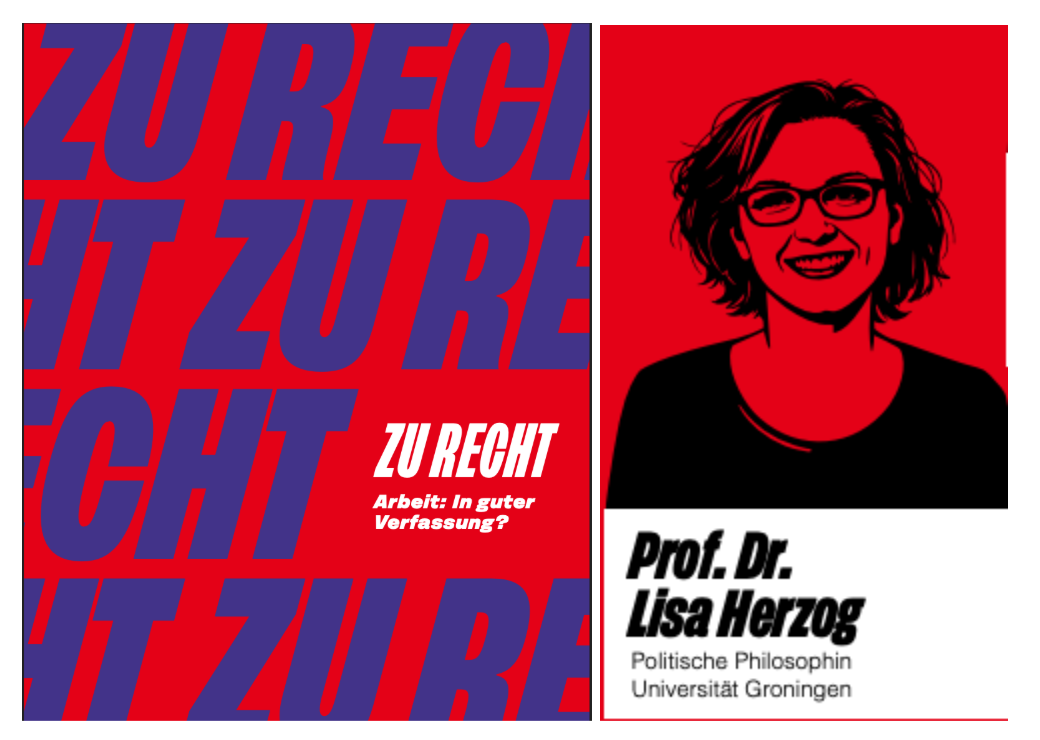
#DW Core Group member Lisa Herzog contributed to the new issue of ZU RECHT, the German Trade Union Confederation (DGB) magazine dedicated to the right to good work. As Germany’s codetermination traditions face pressure from digitalisation and new forms of work, Herzog’s contribution reinforces the case for democratic participation in the firm. Access the full magazine here.
May 30. Alternatives Économiques, Isabelle Ferreras «Pour résoudre les crises, il faut démocratiser les entreprises»

Dans le numéro de juin 2026 d'Alternatives Économiques, le rédacteur en chef Marc Chevallier publie un long entretien avec Isabelle Ferreras, présidente du Comité international d'expert·e·s sur la démocratie au travail mis sur pied par le Gouvernement espagnol. L'entretien expose l'argument central du Rapport : démocratiser l’entreprise en ouvrant la participation aux décisions stratégiques et à la propriété de l’entreprise aux travailleuses et travailleurs constitue une réponse structurelle nécessaire pour faire face aux crises politiques, sociales et écologiques de notre temps. Le texte situe le Rapport espagnol dans le contexte du débat français sur l'avenir du travail et l'horizon électoral de 2027. Lire l'entretien complet ici.
June 3. Público. Una ley de participación de los trabajadores en la empresa, ¡ya!
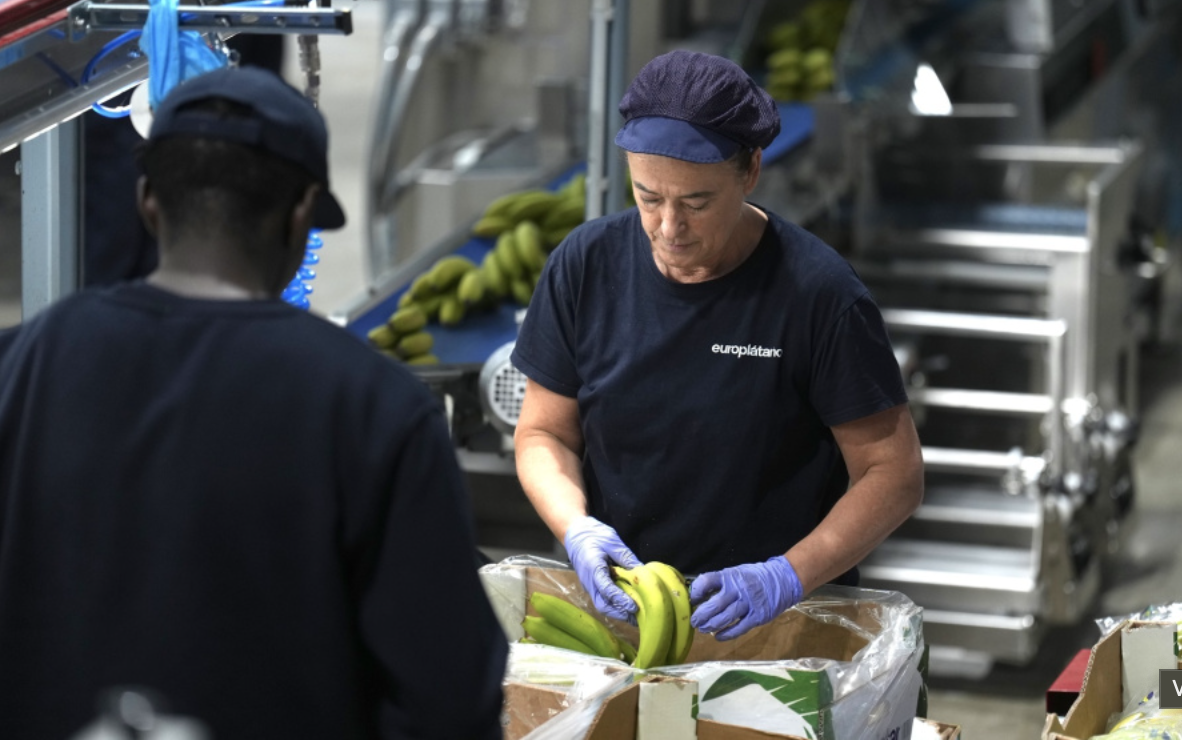
En esta columna publicada en Público, Bruno Estrada argumenta que existe una relación directa entre la mayor productividad de un país y el mayor desarrollo legislativo de la participación de los trabajadores en las empresas. El artículo apoya la aprobación de una ley que haga efectiva dicha participación en España, en línea con las recomendaciones del Informe del Comité Internacional presidido por Isabelle Ferreras y entregado al Gobierno español en febrero de 2026. Leer el artículo completo aquí.
June 10. The Guardian. We economists have done the maths: ‘growth’ is a doomed strategy – there is a better way

Join #DW core group members Pavlina Tcherneva and Isabelle Ferreras, who have signed the op-ed co-authored by Olivier De Schutter, Joseph Stiglitz, Jayati Ghosh, Thomas Piketty, Kate Raworth, and Jason Hickel. It signals the growing momentum behind the Roadmap for Eradicating Poverty Beyond Growth's vision of moving beyond growth-dependent development strategies towards a human rights-based economy centred on well-being, democratic governance, ecological justice, and a decolonial international economic order. The op-ed directly addresses the failed promise of growth as a route to reducing inequality, and points to decommodifying and democratizing work as part of the solution. Read the full article in ENGL here and sign it here. French and Spanish versions are also available.
POLICY-MAKING
April. United Nations. Roadmap for Eradicating Poverty Beyond Growth
Presented officially in April 2026 at a high-level international conference at the International Labour Organization (ILO) in Geneva, the Roadmap for Eradicating Poverty Beyond Growth by UN Special Rapporteur Olivier De Schutter, a #DW Manifesto signatory, puts forward a toolkit of concrete policy measures for building a global economy centred on human rights, ecological justice, and participatory governance. The Roadmap will be officially handed over to the UN General Assembly in NYC on June 25.
In particular, two of its sections directly expose the core proposals identified in the #DemocratizingWork Manifesto to enact its 3 founding principles. Addressing the decommodification of work, Section 2.1 calls for an end to the casualisation of employment, to support fair wages, and the recognition of care work, echoing the Manifesto's call to not treat labour as a commodity. You can read the policy profile here. Section 2.9 addresses the democratisation of the workplace: it includes explicit measures for worker participation at corporate decision-making level, referring to the Report on Democracy at Work commissioned by Spain as reference framework. You can read the policy profile here.
June 4. World Inequality Lab / Paris School of Economics. Global Justice Report

The Global Justice Project sets out a new vision for global progress in the 21st century, grounding human development and equality in planetary habitability. It explores the conditions under which the world could move toward this horizon and traces an economically and ecologically consistent transition path from 2026 to 2100. Launched at the World Inequality Conference in Paris on June 4, 2026, the Report was produced by the World Inequality Lab under the direction of #DW signatory Thomas Piketty and leading economists, and is available in full here. The Report converges with the three pillars of the #DemocratizingWork Manifesto on two fronts in particular. The Spanish Report on Democracy at Work is cited as a concrete framework for the democratic transformation of the economy. On decarbonization, the report maps the structural transformation required to stay below 2°C.
You can watch the panel starting at hour 2:26:00 which includes #DW signatories Ingrid Robyns, Jean Drèze, from the #DW Indian Chapter, and Isabelle Ferreras discussing democratizing work and the economy in the context of the release of this Global Justice Project.
June 2026. Haut-commissariat à la Stratégie et au Plan (France). Comment associer les salariés aux décisions stratégiques des entreprises ?

A breakthrough in France: the Haut-commissariat à la Stratégie et au Plan de la République française is a body inside the French Administration that reports directly to the French Government. Its analyses carry significant political weight, particularly in a presidential pre-campaign context. In its new report, the Bureau asks squarely: how should workers be associated with the firm’s strategic decisions? It concludes that strengthening worker participation on boards of directors cannot rest solely on economic efficiency arguments: it must also be approached as a matter of social democracy, over the long term, to address industrial, environmental, and technological challenges. The report builds on the framework established by the Spanish Report on Democracy at Work and reinforces the case for legislative action in France ahead of the 2027 elections. If you read French, this is a must read! Read the full report here.
NATIONAL CHAPTER - INDIA
February 20. Webinar. When Women Workers Take Over: Voices from Women's Cooperatives
This multilingual webinar brought together representatives from four women worker cooperatives across India: a fisherwomen's cooperative in Andhra Pradesh, a credit cooperative in Gujarat, a tea garden livelihood cooperative in West Bengal, and a curry powder and spices cooperative in Kerala. Participants shared their experiences, challenges, and achievements, offering a vivid picture of what worker ownership looks like from the ground up. The recording is available:
May 20. Ideas for India. Krishna Priya Choragudi. How Worker Cooperatives Enhance Women's Agency
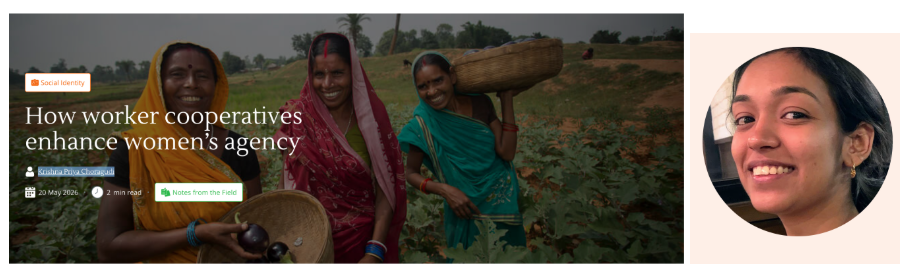
Collective organisation is one way in which workers respond to the precarity of informal work. In this note, Krishna Priya Choragudi examines four women workers’ cooperatives in India – a fisherwomen’s cooperative in Andhra, a credit cooperative in Gujarat, a tea garden cooperative in West Bengal, and a curry powder and spices cooperative in Kerala. She discusses their origins, positive impacts on members, and the challenges that remain. You can read the article here.
PAST EVENTS
May 12. Paris. Sciences Po. Comment démocratiser le travail ?
As France enters its pre-electoral presidential cycle, the question of democratizing work has arrived at the heart of the political debate. Hosted by Bruno Palier and Sciences Po Paris' Laboratory for Interdisciplinary Evaluation of Public Policies, this conference brought together Isabelle Ferreras to discuss the key recommendations coming from the Report to Spain, Thomas Coutrot releasing the Manifeste pour une démocratie du travail, and some of France's most prominent political figures across the left and centre-right: Marine Tondelier (National Secretary of the Greens), Clémentine Autain (MP, Seine-Saint-Denis), Olivier Faure (First Secretary of the Socialist Party), Franck Morel (National Secretary for Labour and Employment, Horizons), and François Ruffin (MP, Somme). The breadth of the political spectrum represented signals that democratizing work is no longer a niche academic proposal: it is becoming an issue of the 2027 presidential campaign. Regardez l'enregistrement (en français) ici:
MAJOR AWARD to Jean Drèze
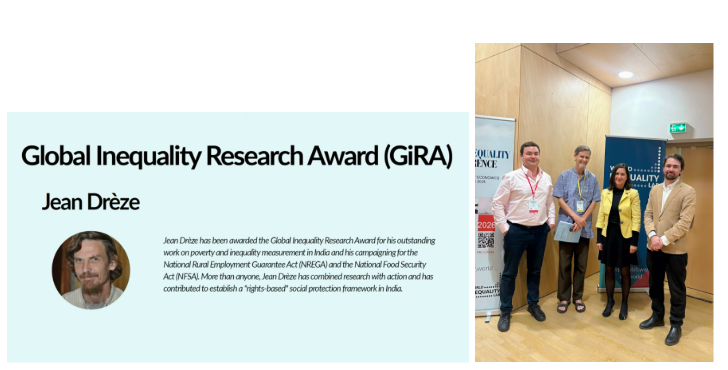
June 5, Paris. World Inequality Lab, Paris School of Economics. Our #DW Manifesto co-signatory and Indian Chapter co-leader Jean Drèze received from Lucas Chancel and Thomas Piketty the Global Inequality Research Award that distinguishes every two years a scholar who has made an outstanding contribution to the understanding of global inequalities. Jean has been a key contributor to the study of India‘s Job Guarantee program. The World Inequality Lab (WIL) and Sciences Po’s Center for Research on Social Inequalities (CRIS) have joined forces to establish a Global Inequality Research Award (or GiRA), which aims to recognize every two years researchers from all disciplines who have made a significant contribution to the understanding of global inequalities.
UPCOMING EVENTS
June 25. Hybrid, Oxford University. Reimagining the Future of Work: Towards a Right to Shape AI
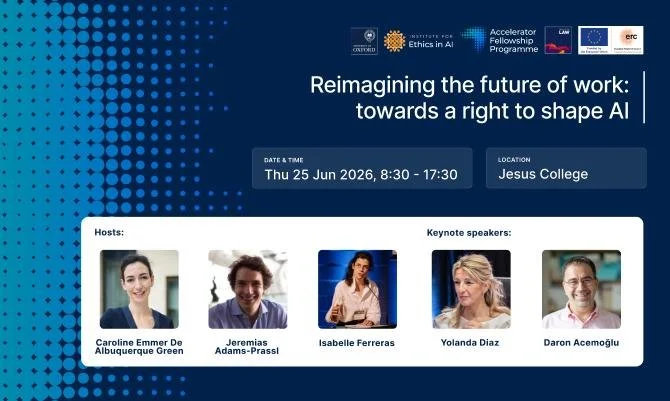
JOIN US ONLINE! A high-level conference co-hosted by the Oxford Institute for Ethics in AI and the Bonavero Institute for Human Rights will bring together policymakers, academics, business and union leaders, and worker representatives from the Global South to explore the right to shape AI as a cornerstone of democratizing work.
The event draws directly on the Report on Democracy at Work drafted for Spain and the European Research Council-funded, Oxford University’s iManage project coordinated by Jeremias Adams-Prassl. Keynote speakers will include Yolanda Diaz, Vice-Prime Minister of Spain and Minister of Labour, who will set out her government’s agenda in support of worker voice and ownership, and economics Nobel laureate Professor Daron Acemoglu, who is championing pro-worker AI. This will be followed by interactive sessions bringing together academics, policy makers and stakeholders from different jurisdictions around the world, discussing the 12 concrete regulatory proposals put forth through this conference and real-life use cases, collaborating to reimagine a future of work characterised by a right to shape AI. Join us online! With English/Spanish live translation on Zoom. Further details to register online or in person here.
June 29. Brussels, Belgium. ETUI / Minerva Think Tank. Board-level employee representation in Belgium: What are the prospects?

Co-organised by the European Trade Union Institute (ETUI) and the Minerva Think Tank, this high-level event tackles a striking gap in European industrial democracy: in Belgium, there is virtually no system of board-level employee representation in for-profit companies. Yet the debate on industrial democracy is experiencing a resurgence, driven by academic research and civil society momentum. The event brings together Isabelle Ferreras to present the Report Two Promises to Those Who Work, examining what its proposals for voice and ownership could mean in the Belgian context and what legislative pathways exist to close the gap with neighbouring countries. The event will have live French/English/Dutch translation. Further details here.
This information-sharing tool is meant to disseminate recent research results, debates, and actual progress with Democratizing, Decommodifying, and Decarbonizing Work within and around our global network. Please share updates from your end. You can share your news about #DemocratizingWork by sending us an email to info@democratizingwork.org.
Onward and upward!
The #DemocratizingWork Core Group,
Julie Battilana, Harvard University, Isabelle Ferreras, FNRS/University of Louvain-Harvard CLJE, Dominique Méda, University of Paris Dauphine PLS, with Alyssa Battistoni, Barnard College, Julia Cagé, Sciences Po-Paris, Neera Chandhoke, University of Delhi, Lisa Herzog, University of Groningen, Imge Kaya-Sabanci, IE Business School, Madrid, Sara Lafuente Hernandez, University of Brussels-ETUI, Hélène Landemore, Yale University, Flavia Maximo, Universidade Federal de Ouro Preto, Brazil, Pavlina R. Tcherneva, Bard College-Levy Economics Institute