
#DW #15 NEWSLETTER
MARCH - APRIL 2026
Breakthrough: Report to Spain
“Two Promises: Voice and Ownership”
Leveraging the Global Conversation from Spain up
Dear signatories of the #DemocratizingWork Manifesto,
A major milestone for our movement: this month of February, the release of the Report Two Promises to Those Who Work: Voice and Ownership, the outcome of the International High-level Expert Committee on Democracy at Work couldn’t have been more impactful! It lays out a bold and practical roadmap to democratise businesses in Spain and in Europe. Presented in Spain and for Spain, the Report is aimed at serving as a starting point for similar conversations in other countries. The aim is for the Report to be relevant in other contexts! Hence it is available in Spanish (500 pages) and in English (400 pages). Please let us know if you want to schedule a conversation around the Report in your country.
At a time when democracy itself is under strain, #DW Core group member Hélène Landemore’s new book: Politics Without Politicians: The Case for Citizen Rule reminds us that democracy is not broken. We just have confined it to a too restricted understanding of the democratic project. Democratizing work is part of this broader democratic awakening: moving from spectatorship to shared rule, in the economy as in polis.
Report commissioned by the Spanish Government released
February 2, 2026, Madrid. Official Presentation of the Report to the Minister of Labour and Social Economy, Yolanda Díaz
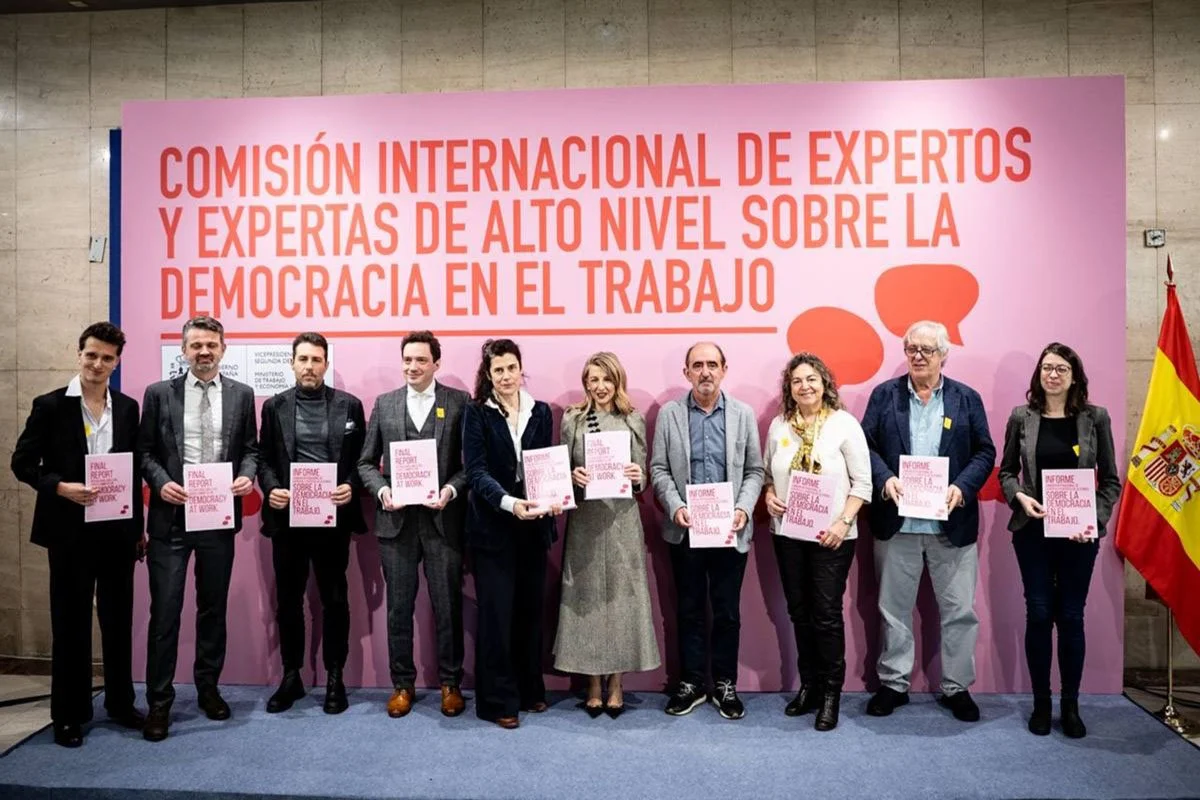
On February 2, 2026, in Madrid, Isabelle Ferreras (#DW co-founder), Chair of the International High-level Expert Committee on Democracy at Work, officially presented the Report Two Promises to Those Who Work: Voice and Ownership to the Second Vice-President and Minister of Labour and Social Economy of the Government of Spain, Yolanda Díaz. The event marked a major political milestone for the democratization of work agenda. Indeed, this is a first step in history: the Government of a European Member State has requested a plan for a full-fledged trajectory toward democratizing businesses. In her reception remarks, Vice-President Díaz hailed the Report’s ambitious roadmap and committed to open an institutional round of social dialogue devoted to the issue. You can watch the full event here, including Isabelle Ferreras’ presentation of the Report and Yolanda Diaz’s response (in Spanish):
SPAIN
The release of the Report has made the news all over Spain and you can access the extensive media coverage. In particular, please find in El País, the op-ed published by Expert Committee Chair, Isabelle Ferreras: “Democratizar la empresa es completar la transición democrática”.
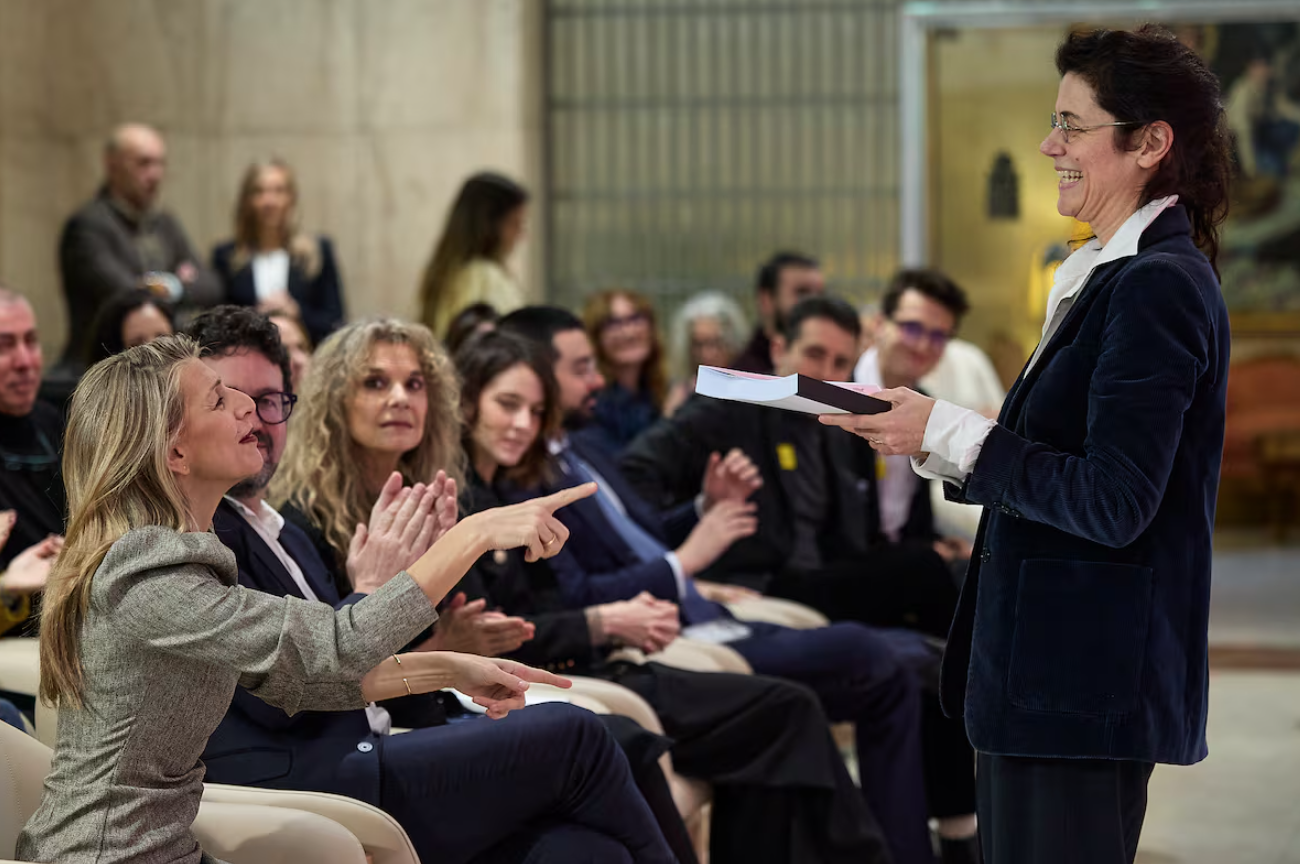
Publicada en El País el 2 de febrero de 2026, la tribuna, Democratizar la empresa es completar la transición democrática, sostiene que la transición española sigue incompleta mientras persistan formas de gobierno autoritarias dentro de las empresas. Isabelle Ferreras defiende una idea central: no puede haber una democracia política plena si la esfera económica continúa organizada bajo lógicas de poder unilateral. A partir de las recomendaciones de la Comisión internacional de expertos y expertas de alto nivel sobre la democracia en el trabajo, la tribuna argumenta que reforzar la voz de las personas trabajadoras en las decisiones operativas y estratégicas, garantizar su presencia en los consejos de administración y ampliar su acceso a la propiedad constituye el siguiente paso lógico en la evolución democrática del país. El mensaje es claro: extender la democracia al gobierno de la empresa no es una ruptura con la transición, sino su culminación.
También, podeis leer el analisis de Antonio Baylos, professor emérito de derecho laboral de la Universidad de Castilla-La Mancha y miembro de la Comisión internacional de expertos o la entrevista de Isabelle Ferreras con El Diario, Entrevista: “Los trabajadores en España no pueden participar en las decisiones que gobiernan sus vidas”
Esta entrevista pone el foco en el déficit democrático que persiste dentro de las empresas españolas: aunque las y los trabajadores invierten su tiempo, su energía y su salud en la organización, carecen de poder efectivo sobre decisiones estratégicas que afectan directamente a sus condiciones de trabajo, al uso de tecnologías como la inteligencia artificial y al rumbo mismo de la empresa. La entrevista subraya que democratizar la empresa no es una cuestión simbólica, sino estructural: implica reconocer a las personas trabajadoras como inversoras de su propio trabajo y, por tanto, como sujetas de derechos políticos dentro del mundo del trabajo. En este sentido, las propuestas de la Comisión internacional de expertos y expertas de alto nivel sobre la democracia en el trabajo, desde la voz y la codecisión hasta la representación en los consejos y la ampliación del acceso a la propiedad, se presentan como instrumentos concretos para reequilibrar el poder y fortalecer la democracia en el corazón de la economía.
A lot is happening in Spain, in the media and in debates! You can follow updates via www.democraciaeneltrabajo.es. The website is updated promptly.
UNITED STATES in February
Following the release of the Report in Spain, efforts were made to directly elevate the conversation to the international level. The Report was presented and discussed in the United States, positioning Spain’s initiative within a broader global debate on the need to strengthen the path toward democratizing the economy.
On February 4th, Vice-President Yolanda Diaz, delivered the John T. Dunlop Memorial Forum on the Report Two Promises to Those Who Work: Voice and Ownership.
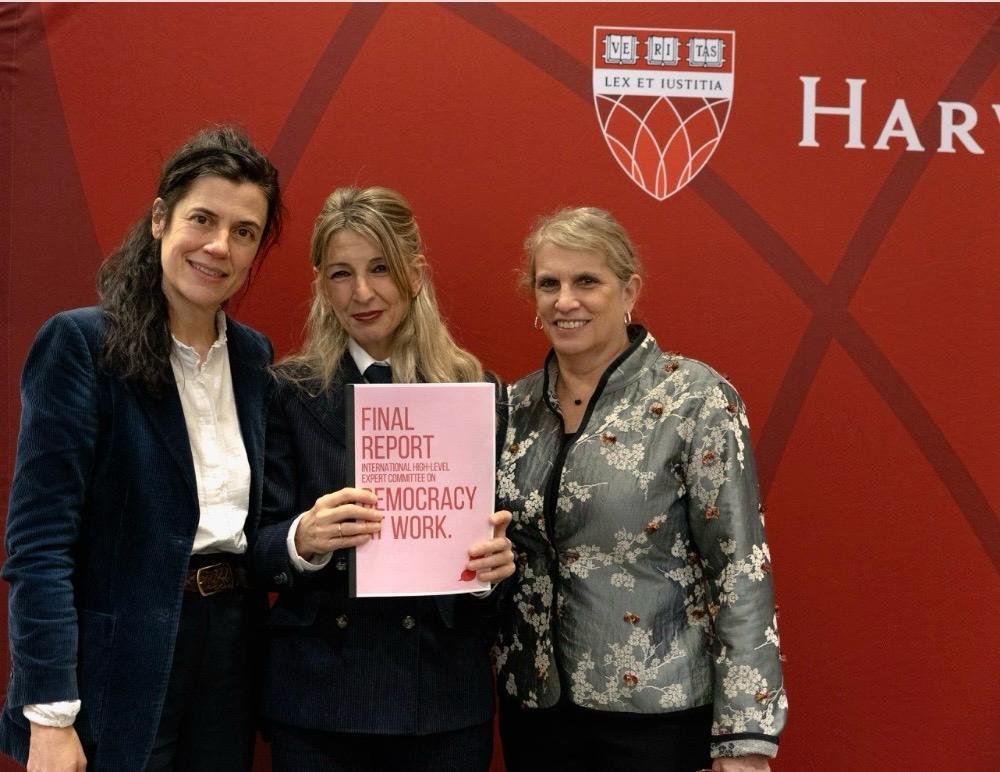
The annual John T. Dunlop Memorial Forum at Harvard Law School honors a distinguished contributor in the field of industrial relations and labor and is hosted by the Harvard Trade Union Program housed at the Harvard Center for Labor and a Just Economy. This year, it featured Yolanda Díaz Pérez, Minister of Labor and Social Economy of the Government of Spain. Her remarks were introduced by Professors David Weil, Sharon Block and Isabelle Ferreras. You can watch the event here:
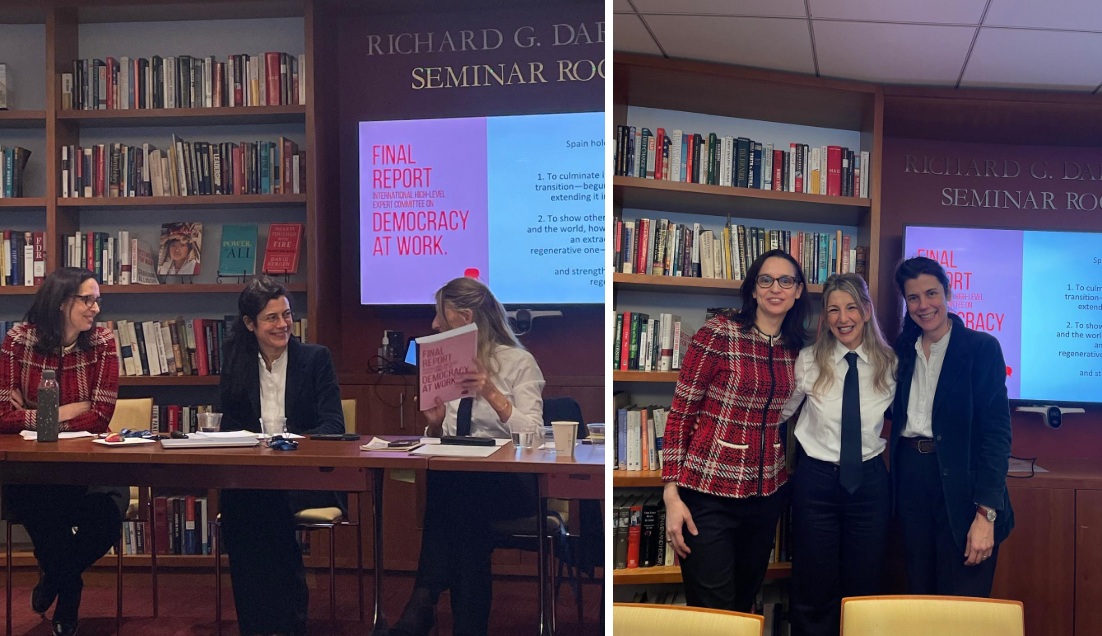
Earlier in the day, #DemocratizingWork co-founders, Julie Battilana and Isabelle Ferreras, member and chair of the Expert committee, discussed the Report with Vice-President Yolanda Diaz at a briefing breakfast hosted by SICI and the CLJE at Harvard Law School.
In English, please read Isabelle Ferreras’ op-ed for Social Europe: Democratise Firms to Save Democracy and the Planet
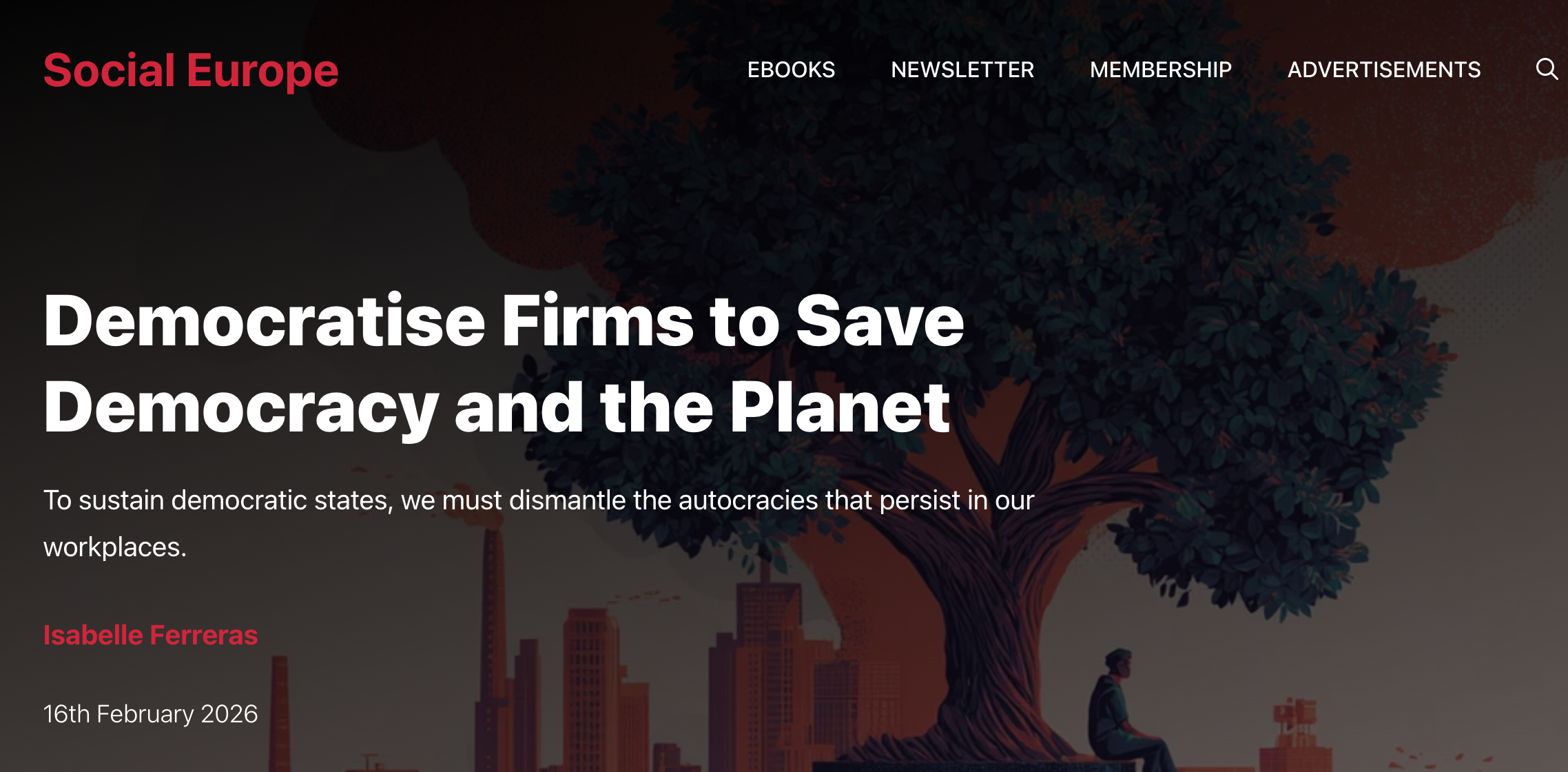
In this op-ed, Isabelle Ferreras argues that the democratic and ecological crises are deeply intertwined, both rooted in the concentration of power within firms governed by shareholder primacy and insulated from democratic accountability. Democratizing the governance of firms becomes a constitutional and planetary imperative. Drawing on the twin pillars of voice and ownership, it calls for embedding workers as co-governing actors, through board-level representation, co-decision rights including over AI deployment, and expanded access to capital ownership, so that economic institutions align with democratic equality and long-term sustainability. Political democracy cannot endure alongside economic autocracy, and ecological transition will remain out of reach unless we transform the governance of the firm itself.
UNITED KINGDOM in March
March 13, 2026. Pelican House, London. Advancing Worker Ownership: Reclaiming Economic Sovereignty in the 21st Century, featuring Benjamin Braun (LSE)
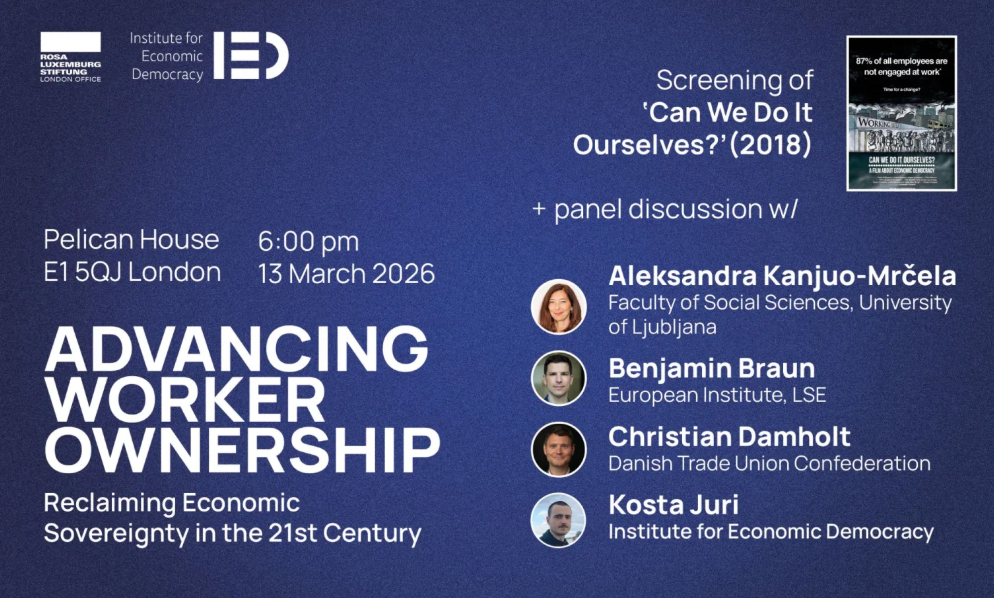
Businesses have become more mobile, more complex, and less accountable. Decisions that shape our lives (such as relocations, layoffs and investments) are increasingly made far from the communities they affect the most, while traditional tools of regulation and trade unions struggle to keep up. If we want to protect democracy and economic sovereignty, we must rethink ownership itself. Democratic worker ownership offers a radical yet practical and time-tested alternative. It anchors wealth, jobs, and decision-making locally, strengthening democracy at work and beyond and giving people a sense of agency over their lives. It reduces inequality not only through redistribution, but by reshaping how value is created and shared in the first place. And as if this wasn't enough, it's even good for business; worker-owned firms consistently prove resilient and competitive. Today, worker ownership remains marginal virtually everywhere, being held back by institutional bias, financing barriers, and limited awareness. Member of the International Expert Committee on Democracy at Work, Benjamin Braun (LSE) will be discussing the Expert Committee’s Report to the Spanish Government, and its proposals regarding access to ownership. Including a screening of the documentary: “Can We Do it Ourselves?” (2018). To know more, click here.
March 30, 2026. London School of Economics: Miliband Lecture on Economic Democracy, featuring Isabelle Ferreras and Mathew Lawrence (Commonwealth)
Is a democratic economy possible? Lessons from history, horizons for the future (In-person and online public event)
Fifty years after powerful labour movements launched radical plans to democratise the economy and gain control of large businesses, what is the legacy of these efforts and what are the prospects for economic democracy today? Join us to discuss the anniversary of the « Meidner plan », a famous moment in the history of socialism when Swedish unions tried to take ownership of all large companies there. In this context, Isabelle Ferreras will discuss the Report commissioned by the Spanish Government: Two promises to Those Who Work: Voice and Ownership. You can register here.
FRANCE in April
Our hope is that the Report will serve as a catalyst for advancing the debate country by country. France has already begun to seize this momentum. Building on the framework of voice and ownership, France is organizing a 2-day dedicated conference bringing together elected officials, trade unions (CGT, CFDT, …), progressive business (Impact France, …) and environmental leaders, like Cyril Dion and Claire Nouvian, and scholars to examine the relevance of the Report for France and tailor its proposals to the specificities of its institutional context.
April 9-10, 2026. Université de Lille-Sciences Po Lille, Université de printemps : Entreprises & Démocratie : à la croisée des chemins. Enjeux et perspectives nationales et européennes. (Event in French)
Pour son lancement officiel, la Chaire 3D&C organise une Université de printemps, « Entreprises et Démocratie ». Durant deux jours, chercheur·ses et acteur·rice·s de la société civile débattent ensemble de l’avenir de notre système productif sur en partant d’un constat : celui d’un changement d’ère. La phase néolibérale se clôt, dans le chaos, et deux voies s’ouvrent à nos sociétés : la clôture nationaliste-autoritaire illibérale ou le rebond démocratique autour de valeurs sociales et écologiques partagées. Ce rebond concerne, aussi, nos manières de déterminer l’objet et le processus de production. La dynamique de cette Université trouve sa source dans l’extraordinaire espoir qu’ouvre – au moment où la démocratie semble attaquée de toute part – le rapport du Comité international d’expert·es de haut niveau sur la démocratie au travail. Avec la participation de Yolanda Diaz (online), Julie Battilana (online), Dominique Méda et Isabelle Ferreras, Corentin Gombert, Thomas Coutrot, Claire Nouvian, Cyril Dion, etc. Pour s’inscrire, cliquer ici.
Le Monde a publié le 10 février la tribune d’Isabelle Ferreras qui explique les enjeux de ce Rapport remis au Gouvernement espagnol, pour l’Espagne et au-delà.
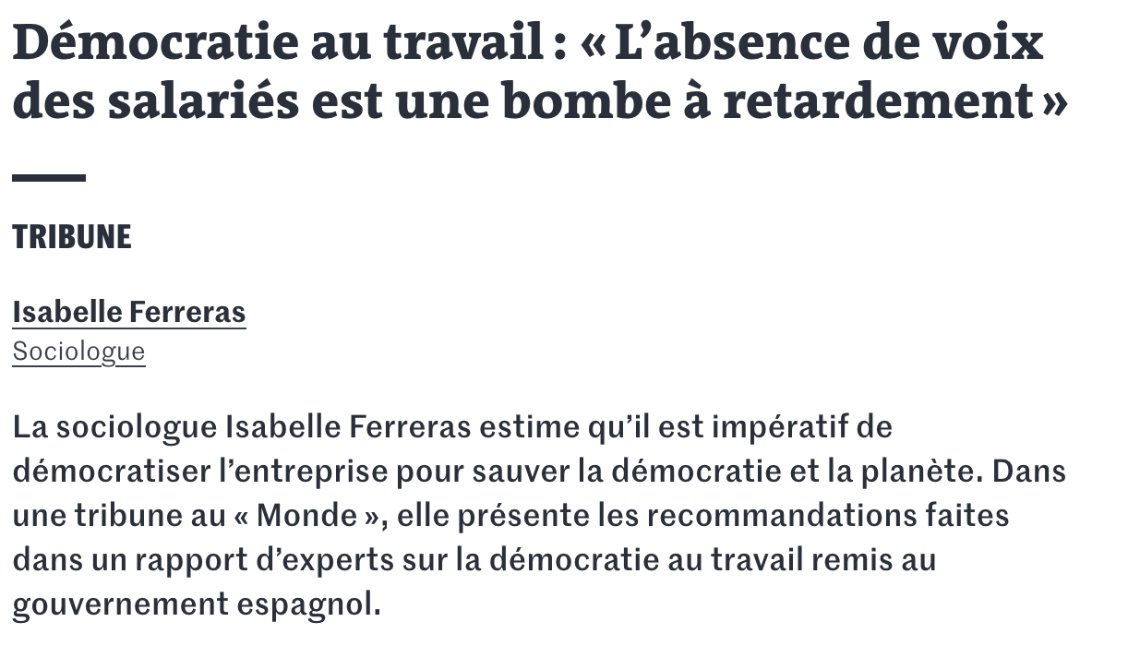
Isabelle Ferreras soutient que la marginalisation persistante des salarié·e·s dans la gouvernance des entreprises constitue un risque systémique pour nos démocraties. Alors que les entreprises structurent profondément nos vies sociale, économique et environnementale, leur fonctionnement reste largement soustrait aux principes de délibération et de représentation qui fondent l’État de droit et la possibilité d’un avenir démocratique et durable. Cette asymétrie crée une tension croissante entre démocratie politique et autocratie économique. La tribune s’appuie sur les conclusions du Comité international pour rappeler que la participation des travailleur·euse·s aux décisions et à la propriété n’est ni utopique ni accessoire : elle constitue une condition de stabilité démocratique et de transition écologique.
More global coverage
More coverage from various countries: The news of the release of the Report was covered across various countries, including Mexico, and languages, a.o. Polish, Italian, German and more. See in particular: An appeal for businesses to be democratised (available in Polish, Italian, Spanish, German, French) published on February 11, 2026 in Industrial Relations Notes: The article covers the release of the Report on Democracy at Work to the Spanish Government. It highlights the growing momentum around worker ownership as a structural response to capital concentration, and the rise of AI at work. The note underscores the role of trade unions, policymakers, and research institutions in shaping frameworks that combine voice and ownership. Rather than treating worker voice and ownership as a niche alternative, the article presents it as a pragmatic pathway toward rebalancing power within the corporation and embedding democratic principles at the heart of the economy, including an interview with Expert Committee chair Isabelle Ferreras who highlights the Committee’s proposal of a right to co-design and consent to AI to be exercised by Works Councils, including at the EU level. The article is available in French, German, Italian, Polish and Spanish. For more coverage go to https://reportondemocracyatwork.org/en/press/.
#DW /ASETT GLOBAL WORKSHOP SERIES 25-26
12 February 2026. Democracy at Work: Introducing the Report commissioned by the Spanish Government about Democracy at Work to our Global Community
We discussed the Report in Spanish with Joaquín Pérez Rey (Secretary of State for Labor in the Government of Spain); Fernando Luján de Frías (Deputy General Secretary for Trade Union Policy, UGT); Jone Nolte Usparicha (Manager at ASLE); Fred Freundlich (Professor at Mondragon University); while Isabelle Ferreras gave a 20 minute overview of the Report in English presented.
Join us for the next workshop!
26 March 2026. AI and Democracy at Work
We’re thrilled to announce the launch of the next edition of the #DemocratizingWork Global Workshop Series, co-organized with ASETT. The first seminar of the series will host stellar speakers to discuss the Spanish Report. To register, fill this form.
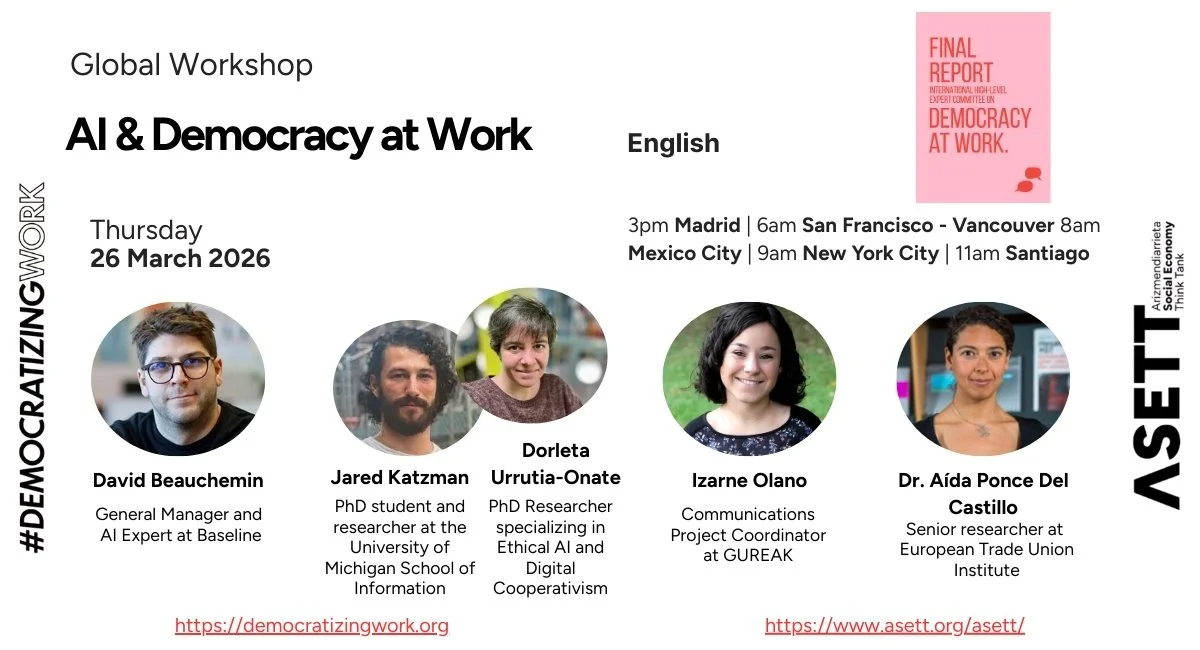
The policy proposals of the Report submitted to the Spanish Government are presented as a critical antidote to the disruptions AI introduces in the world of work, ensuring innovation aligns with social justice and workers’ rights. The session will explore under which conditions artificial intelligence can be mobilised as a tool to strengthen democracy at work, rather than undermine it. We will look at how cooperatives are leading in this direction. The panelists will discuss the proposals made in the Report. They include Jared Katzman (Researcher, University of Michigan) & Dorleta Urrutia-Onate (University of Mondragon, Aída Ponce Del Castillo (Senior Researcher, European Trade Union Institute), Izarne Olano (Manager, GUREAK) and David Beauchemin (General Director and AI Expert, Baseline), chaired by Hélène Landemore (#DW core group member, Yale)
PAST EVENTS
January 22, 2026, Davos (Switzerland). World Economic Forum. Hélène Landemore: Is Democracy in Trouble?
At the 56th Annual Meeting of the World Economic Forum, Hélène Landemore, (#DemocratizingWork core group member), participated in a high-level discussion on the future of democracy in a year marked by unprecedented civic participation. Alongside Shekhar Gupta, Edwin Tong Chun Fai, Fernando Hugo Aramayo, and Sviatlana Tsikhanouskaya, Landemore addressed the urgent question of how to safeguard openness and the free exchange of ideas amid polarization and institutional fatigue. The discussion highlighted the importance of transparency, accountability, and consistency as foundations of trust, while underscoring the need to innovate democratic practices beyond electoral moments, including in the realm of corporate governance, an approach closely aligned with the principles of democratizing work and citizen participation that animate our network.
February 5, 2026, Paris (France). Assises de la Démocratie en organisations : Outiller la démocratie en organisation
La 3ᵉ édition des Assises de la Démocratie en Organisations se tiendra le 5 février 2026 à Paris. C’est une journée de réflexion, d’échanges et de co-production collective dédiée à l’ambition d’« outiller la démocratie » au sein des organisations et des lieux de travail. Porté par un laboratoire d’idées réunissant praticien·ne·s et chercheur·se·s engagé·e·s dans la transformation démocratique des organisations, l’événement fédère communautés académiques, mouvements syndicaux, acteurs politiques et professionnel·le·s souhaitant approfondir et concrétiser des pratiques de démocratie économique et sociale. Parmi les interventions, Isabelle Ferreras a donné une brève présentation du Rapport remis au Gouvernement espagnol deux jours plus tôt et a échangé avec Charles Fournier (député à l’Assemblée nationale française) à propos du projet de loi qu’il a déposé pour permettre la démocratisation des entreprises en France.
February 26-27, 2026, Bochum (Germany). EuroDem Conference. Worker Participation in Algorithmic Management and AI
At the EuroDem Conference Between Practice and Research: Democratization of Work in the Realm of Transfer Research, Holm-Detlev Köhler (University of Oviedo, Spain) examined how algorithmic management (AM) and artificial intelligence (AI) are reshaping labour relations—largely without workers’ participation. Hosted by Ruhr-University Bochum at the Institute for Social Movements, the paper is part of the research project Workplace democracy: a European ideal? Discourses and practices about the democratization of work after 1945 (EURO-DEM), funded by the ANR and DFG.
Köhler argues that AM and AI mark a qualitative break from earlier technological shifts. Beyond automation, they enable pervasive surveillance and the extraction of workers’ tacit knowledge into learning systems—amounting to a new form of skills expropriation. Drawing on his involvement in Eurofound’s project on Collective bargaining and social dialogue regarding AI and AM in the EU, he shows that digitisation often increases efficiency at the cost of work intensification, routinisation, and reduced autonomy. A key finding highlights the paradox of digital work: technologies that augment cognitive capacity simultaneously function as instruments of managerial control. Whether digitisation empowers or disempowers workers depends on institutional frameworks, regulation, and, crucially, the presence of worker participation and collective bargaining in the governance of AI at work.
Featured book: NEW BOOK OUT!
Politics Without Politicians. The Case for Citizen Rule (Thesis, 2026) Hélène Landemore
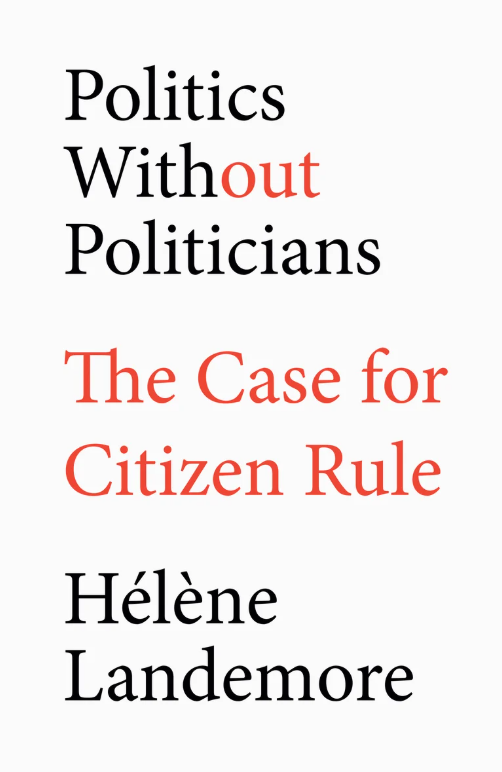
Politicians have failed us. But democracy doesn’t have to. Bought by special interests, detached from real life, obsessed with reelection. Politicians make big promises, deliver little to nothing, and keep the game rigged in their favor. But what can we do? In Politics Without Politicians, #DW core group member Hélène Landemore asks and answers a radical question: What if we didn’t need politicians at all? What if everyday people, under the right conditions, could govern much better? With disarming clarity and a deep sense of urgency, Landemore argues that electoral politics is broken but democracy isn’t. We’ve just been doing it wrong. Drawing on ancient Athenian practices and contemporary citizens’ assemblies, Landemore champions an alternative approach that is alive, working, and growing around the world: civic lotteries that select everyday people to govern—not as career politicians but as temporary stewards of the common good. When regular citizens come together in this way, they make smarter, fairer, more forward-thinking decisions, often bringing out the best in one another. You can order the book here. Here you can also watch a recent book talk by Hélène:
Witnessing this process firsthand, Hélène Landemore has learned that democracy should be like a good party where even the shyest guests feel welcome to speak, listen, and be heard. With sharp analysis and real-world examples, drawing from her experience with deliberative processes in France and elsewhere, Landemore shows us how to move beyond democracy as a spectator sport, embracing it as a shared practice, not just in the voting booth but in shaping the laws and policies that govern our lives. This is not a treatise about what’s wrong, it’s a book about what’s possible. A must-read! While democratizing work is about extending the democratic project into the oikos, Hélène Landemore’s work is after deepening it into the oikos. These are two mutually necessary movements if we want the democratic project to flourish.
This information-sharing tool is meant to disseminate recent research results, debates, and actual progress with Democratizing, Decommodifying, and Decarbonizing Work within and around our global network. Please share updates from your end. You can share your end of the news about #DemocratizingWork by sending us an email to info@democratizingwork.org.
Onward and upward!
The #DemocratizingWork Core Group,
Julie Battilana, Harvard University, Isabelle Ferreras, FNRS/University of Louvain-Harvard CLJE, Dominique Méda, University of Paris Dauphine PLS,
With Alyssa Battistoni, Barnard College, Julia Cagé, Sciences Po-Paris, Neera Chandhoke, University of Delhi, Lisa Herzog, University of Groningen, Imge Kaya-Sabanci, IE Business School, Madrid, Sara Lafuente Hernandez, University of Brussels-ETUI, Hélène Landemore, Yale University, Flavia Maximo, Universidade Federal de Ouro Preto, Brazil, Pavlina R. Tcherneva, Bard College-Levy Economics Institute