#DW #16 NEWSLETTER

MAY DAY 2026

The Conversation on Democracy at Work Continues to Grow


Dear signatories of the #DemocratizingWork Manifesto,

As May Day approaches this year, the reasons for concern are profound. Wars are raging, inequalities are rising, and political democracy is under threat across the globe.

Yet, we see hope. The Report on Democracy at Work, commissioned by the Spanish Government, was presented in February as a blueprint for Spain, but it is now serving as a catalyst for similar conversations worldwide. On the eve of May Day, the resonance of this plan is spreading far beyond the Spanish borders. France, for instance, is taking the discussion to the next level, integrating democratizing work into its upcoming presidential elections’ core debates.

The Report has already sparked significant engagement internationally. It was recently the focus of a two-day conference in Lille, France, which gathered more than 300 participants—including progressive business leaders, union representatives, environmental activists, academics, and journalists.

Meanwhile, the conversation remains vibrant in Spain, where events are being held across various cities and civil society actors are actively debating the Report's proposals. International press coverage has surged, particularly in Germany and Belgium, and the momentum continues to grow globally.

At the global level: the Report’s recommendations have been integrated into the UN Special Rapporteur’s Global Roadmap for Eradicating Poverty Beyond Growth, which will be presented at the UN General Assembly this June. The dialogue is set to expand even further with upcoming events in various countries.

Stay tuned! A full overview of related events and press coverage is constantly being updated. Join these events, or please let us know if you want to schedule a discussion around the Report in your country!

Again, you can access the full Report  in Spanish (500 pages) and in English (400 pages), with a 5-page executive summary and a 26-page comprehensive summary, and the Introduction of the Report in Spanish, English, and French.   

MEDIA AND PRESS COVERAGE

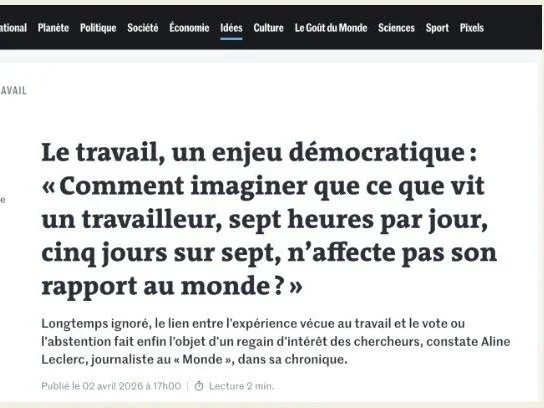
April 2. Le Monde. Le travail, un enjeu démocratique : « Comment imaginer que ce que vit un travailleur, sept heures par jour, cinq jours sur sept, n’affecte pas son rapport au monde ? »

Longtemps ignoré, le lien entre l’expérience vécue au travail et le vote ou l’abstention fait enfin l’objet d’un regain d’intérêt des chercheurs, constate Aline Leclerc, journaliste au « Monde », dans sa chronique. Voir la suite de l’article ici. 

April 2. ElDiario.es. ¿Por qué la patronal rehúye el debate sobre democracia en la empresa?

El debate sobre la democracia en el trabajo sigue avanzando en España, con los primeros pasos hacia la apertura de un diálogo social orientado a implementar algunas de las recomendaciones del informe. En este contexto, surge una cuestión clave: ¿por qué las organizaciones empresariales españolas han decidido no sentarse a debatir sobre la participación de los trabajadores en las empresas? Lo que está en juego no es una propuesta coyuntural, sino el desarrollo de un mandato constitucional pendiente desde hace casi medio siglo. Este debate pone de relieve tanto las resistencias actuales como la urgencia de avanzar hacia formas más democráticas de organización empresarial. Para leer el artículo completo, ver aquí

April 6.  La Voix Du Nord. Démocratisation de l’économie: la volonté espagnole et le rapport lillois

Le rapport continue à animer des discussions en France. Pour voir l’article complet cliquez ici.

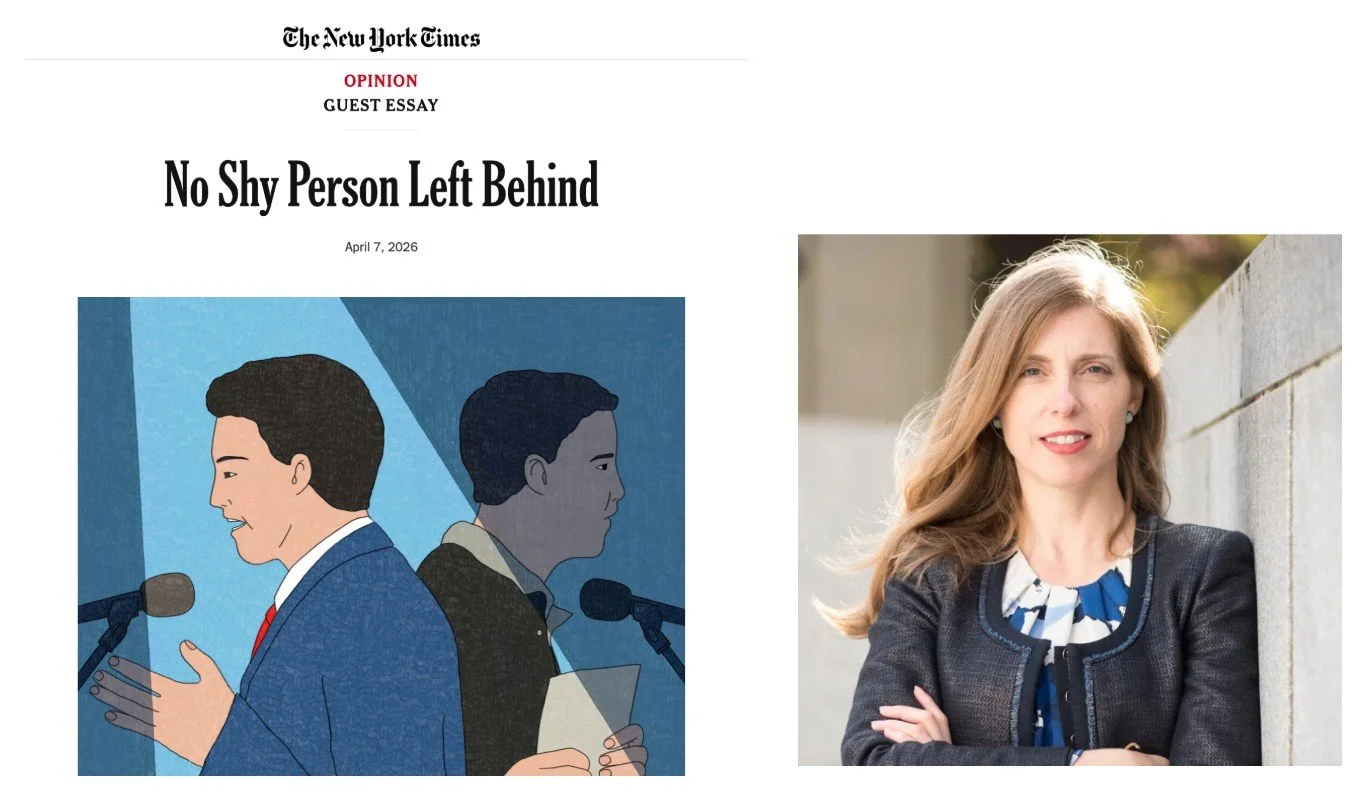
April 7. New York Times. Op-ed from Hélène Landemore, ​​No Shy Person Left Behind

#DW core group member Hélène Landemore (Yale University) argues in a recent New York Times op-ed that contemporary democracy is structurally biased toward the loudest and most performative voices, thus leaving aside the majority who feel politics is not meant for them. Drawing on her research, she highlights citizens’ assemblies as a powerful institutional innovation capable of “bringing out the shy”: ordinary people, selected by lottery, who deliberate, learn, and collectively shape public decisions. These assemblies, already spreading globally, demonstrate that more inclusive and deliberative forms of democracy can lead to more legitimate, thoughtful, and widely supported outcomes. Her piece makes a compelling case: democratizing our institutions also means redesigning them to include those too often left unheard. Read the article here.

April 13. Social Europe. Stan De Spiegelaere, From Hitler’s Industrialists to Trump’s Tech Bros: The Case for Democracy at Work

In his piece, Stan De Spiegelaere highlights how quickly corporate elites can align with political power, pointing to the symbolic image of tech leaders rallying behind Donald Trump. While not unprecedented, this dynamic raises familiar risks: when unchecked, corporate power can enable democratic backsliding. The antidote, he argues, lies in workplace democracy. In this context, the recent Spanish report on democracy at work offers a timely and concrete roadmap, proposing measures such as worker representation on boards, employee ownership, and support for cooperative transitions. More than an institutional reform, democratizing work emerges here as a necessary safeguard for democracy itself.  To read the article in full, click here.

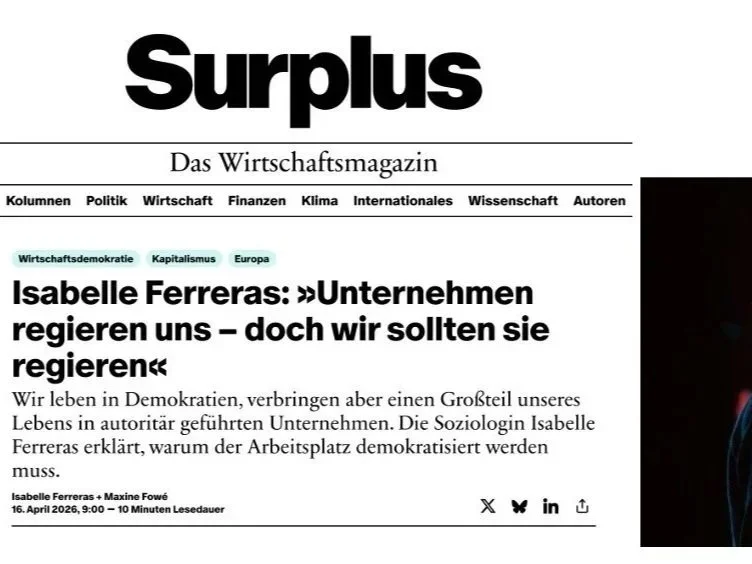
April 16. Surplus. Isabelle Ferreras: »Unternehmen regieren uns – doch wir sollten sie regieren«

Spanien lässt gerade prüfen, was anderswo kaum politisch umgesetzt wird: Wie kommt die Demokratie in den Betrieb? Den Bericht dazu hat die Soziologin Isabelle Ferreras mit einer internationalen Expertenkommission für die Regierung in Madrid erarbeitet. Im Surplus-Interview spricht Ferreras über Unternehmen als Orte privater Herrschaft, weshalb Beschäftigte die eigentlichen Investoren eines Betriebs sind – und was wirtschaftliche Demokratie praktisch bedeutet. To read the article in full, click here.

NATIONAL CHAPTER

ITALY

Non c'è salute senza lotta. Per un’ecologia del lavoro tra fabbriche e territori (Fondazione Giangiacomo Feltrinelli, 2026) Ed. Paolo Borghi, Gino Carpentiero, Ivano Scotti

Non c’è salute senza lotta nasce dall’incontro tra Democratizing Work e Medicina Democratica in un tempo segnato da crisi che si ripetono nei luoghi di lavoro. Attraverso una pluralità di voci, il volume mette al centro la sicurezza come tema politico, che riguarda persone, organizzazione del lavoro e qualità della democrazia. Lavoro, salute e ambiente parlano la stessa lingua. Le fabbriche, i territori, le vertenze operaie e le sfide della transizione ecologica sono strettamente collegati: non esiste tutela della salute senza partecipazione, non esiste giustizia ambientale senza giustizia sociale. Le esperienze concrete di lotte e di alleanze permettono di immaginare un’alternativa che rifiuta le semplificazioni e intreccia lavoro e ambiente, sicurezza e democrazia, conflitto e futuro. For more information see here.

UPCOMING EVENTS

April 27. Madrid. Agrupación Europeísta Ateneo.  High-level event: Democracia en el trabajo: Presentación del Informe

El informe sigue generando un intenso debate en España, reuniendo a actores clave del mundo académico, sindical y de la sociedad civil.  Este encuentro de alto nivel, en Madrid, contará con la participación de la Vice-Presidenta segunda del Gobierno Yolanda Díaz, Antonio Baylos (miembro de la Comisión de expertos), Toni Ferrer, Paloma López y Susana Huertas, y será moderado por Santos M. Ruesga, con la introducción y presentación de Juan Antonio Gimeno. Organizado por la Agrupación Europeísta del Ateneo, la Sección de Ciencias Económicas y la Plataforma por la Democracia Económica, el evento tendrá lugar el lunes 27 de abril a las 18:30 en el histórico Ateneo de Madrid.

May 12. Paris. Sciences Po. Comment démocratiser le travail? 

Alors que l’extrême-droite semble poursuivre sa marche inexorable vers le pouvoir, divers travaux scientifiques récents montrent que sa progression chez les salariés s’explique en grande partie par l’effritement de leur autonomie, leur isolement, le sentiment de ne pas être écoutés : bref, un manque de démocratie au travail.

Pourtant les travailleurs et travailleuses aspirent profondément à pouvoir peser dans les décisions qui les concernent au quotidien. Le Manifeste pour une démocratie du travail, publié ce 17 avril par les Ateliers Travail et Démocratie, et coordonné par Thomas Coutrot, souhaite rendre visibles et promouvoir les initiatives d’enquêtes, de luttes et d’alternatives qui se fondent sur la puissance du travail vivant et rompent ainsi avec la résignation. Ce Manifeste propose des mesures qui rejoignent ou complètent celles déjà avancées dans le cadre du projet et de louvrage “Travailler Mieux”, coordonnés par Christine Erhel et Bruno Palier, et dans le rapport “Deux promesses à celles et ceux qui travaillent : voix et propriété“, coordonné par Isabelle Ferreras à la demande du gouvernement espagnol.

La conférence vise à présenter ces propositions de façon succincte, puis de les mettre en débat avec des responsables politiques. Les propositions seront présentées par Les responsables politiques - et candidat·e·s - qui s’exprimeront seront Clémentine Autain (députée de Seine-Saint-Denis), Xavier Bertrand (Président du Conseil régional des Hauts-de-France, ancien ministre du Travail),  Olivier Faure (Premier secrétaire du Parti Socialiste) Franck Morel (ancien conseiller social d’Edouard Philippe, secrétaire national de Horizons en charge du travail et de l’emploi), François Ruffin (député de la Somme), Marine Tondelier (Secrétaire nationale des Écologistes). 

L’évènement aura lieu le 12 mai 2026 de 17:30 à 19:30 à l’Amphithéâtre Simone Veil. 28 rue des Saints-Pères, 75007, Paris. 
Pour plus d’information: voir ici.

June 3. Québec, Canada. CIRA’s 2026 conference

The 63rd Annual CIRA Conference is taking place from June 2 to 4, 2026, at Université Laval, Quebec City, Quebec. During the annual meeting of the Canadian Industrial Relations Association (CIRA), Isabelle Ferreras has been invited to give the H.D. Woods lecture to present the Report on Democracy at Work to the Spanish Government on this occasion. Further details are available here.

June 4-6. Paris School of Economics. World Inequality Conference

The World Inequality Conference will be structured around three pillars: (1) Release of the Global Justice Report on June 4;  (2) plenary sessions reflecting on the main themes of the report and (3) parallel sessions featuring the latest academic work in the inequality field. Speakers include #DW core group member Julia Cagé, Jason Hickel, Jayati Ghosh, Mariana Mazzucato, Thomas Piketty, Lea Ypi and Gabriel Zucman. Isabelle Ferreras will discuss the Report of the Expert Committee on Friday June 5th in a Plenary Session: ‘How Much Should the Wealth Scale be Compressed?’ alongside Jean Drèze and Ingrid Robeyns

The full programme of the conference is available here.

PAST EVENTS

March 26. Online, #DW / ASETT Global Workshop Series. AI & Democracy at Work

We discussed the report’s proposals with regard to AI and its potential for Democracy at Work with Jared Katzman (Researcher, University of Michigan) & Dorleta Urrutia-Onate (University of Mondragon), Aída Ponce Del Castillo (Senior Researcher, European Trade Union Institute), Izarne Olano (Manager, GUREAK) and David Beauchemin (General Director and AI Expert, Baseline). 


You can watch the recording here:

March 30. London School of Economics. Miliband Lecture on Economic Democracy, featuring Isabelle Ferreras and Mathew Lawrence (Commonwealth)

What can we learn from the ambitions and failures of projects like this? What should plans for economic democracy look like today? And what is the best way to pursue projects for economic democracy in practice? #DW core group coordinator Isabelle Ferreras introduced the Report on Democracy at Work prepared for Spain in the context of the 50th anniversary of the Meidner Plan, in dialogue with Mathew Lawrence (Common Wealth’s Founder and Director) and Neil Warner (Postdoctoral Fellow at the European Institute). 

The recording is available here:

April 9-10, Université de Lille-Sciences Po Lille, France. Démocratiser l’entreprise pour sauver la démocratie et la planète

Réunissant plus de 300 participant·es, l’Université de printemps s’est penchée durant 2 jours sur le rapport du Comité international d’expert·es de haut niveau sur la démocratie au travail. Les échanges ont discuté le Rapport et ses propositions dans le contexte français et européen. Parmi les intervenant·es, les membres du core group de #DW Dominique Méda, Julie Battilana, ainsi que des personnalités publiques telles que Benoît Hamon et Claire Nouvian, les organisations syndicales, CFDT et CGT, et patronales progressistes, Impact France, le CJD et la Convention des entreprises pour le Climat.

Revivez les présentations et les débats via les enregistrements des séances plénières : 

https://webtv.univ-lille.fr/grp/782/entreprises-amp-democratie-la-croisee-des-chemins/

April 8, Portland. Consider This: What Democracy Needs with Hélène Landemore

A conversation with Hélène Landemore, author of Politics Without Politicians, on what democracy must become to meet the complexity, speed, and scale of today’s world.

April 22. ILO, Geneva - United Nations - A Global Roadmap for a New Economy

The United Nations Special Rapporteur and #DW signatory Olivier De Schutter has integrated the recommendations laid out in the Report on Democracy at Work as part of the Special Rapporteur’s Global Roadmap for Eradicating Poverty Beyond Growth. The Roadmap aims to support international human rights-based efforts towards reducing inequalities and ending poverty within planetary boundaries. It is the most comprehensive attempt at developing a full policy roadmap to track measures to Democratize, Decommodify, and Decarbonize work - alongside key proposals such as a Job Guarantee. You can read the report here.

April 23. #DW - ASETT Global Workshop Series. Democratizar el trabajo: Perspectivas iberoamericanas

El último workshop se centró en las recomendaciones del informe y cómo pueden inspirar reformas más allá de Europa. En América Latina, sus propuestas pueden orientar iniciativas que fortalezcan la participación de las personas trabajadoras y el diálogo social en economías en rápida transformación, asegurando que los principios democráticos se integren en los sectores emergentes.

Contamos con la participación de Eric Campos (Secretario General de la Central Unitaria de Trabajadores y Trabajadoras de Chile), Luis Gutierrez (Coordinador de Economía Social del Gobierno de México), Daniela Muradas (Profesora, Universidad Federal de Minas Gerais) y Antonio Stecher (Profesor, Universidad Diego Portales).

Puede visionar la grabación aquí:

NEW BOOK

La formazione del socialismo repubblicano in Francia Storia politica del diritto al lavoro (1789-1848). (Firenze University Press, 2026) Pablo Scotto

Despite its broad legal recognition, many do not consider the right to work to be a genuine right. The reason: its identification with the public promotion of full employment, a goal that is probably unattainable in capitalist societies. The right to work therefore appears as a sort of pious wish, if not a dangerous idea: taken seriously, guaranteeing it would require a state that has little respect for private economic initiative. This book recovers an alternative conception of it. Coined by Fourier in the early 19th century, the ‘right to work’ is reinterpreted in 1848 by a new type of socialism, heir of the republican and democratic thought of the French Revolution. This socialism does not expect the state to control the entire economy, but rather that the world of work be governed by the same egalitarian principles that regulate the political sphere. The book is available in open access here.

NEW RESEARCH

March. The Extractive Industries and Society. Benjamin Selwyn, Twin transitions and systemic ecocide: revisiting Jevons in the era of digitalised global value chains 

Digital technologies are widely promoted as catalysts of a “twin transition” that can simultaneously boost competitiveness and reduce the environmental harm caused by global value chains (GVCs). In this article, Benjamin Selwyn, University of Sussex, deploys a political ecology approach to frame the contemporary digital–GVC nexus through Jevons’ paradox: efficiency gains that lower unit costs tend to expand aggregate output. It advances the concept of systemic ecocide to describe the slow, cumulative, and predictable destruction of ecosystems that follows from technoeconomic expansion under competitive accumulation. The analysis shows how digital technologies enabled the rise of modern supply chains, intensify extraction, and deepen environmental burdens across the lifecycle—production, use, and post-use e-waste. The conclusion outlines research and policy agendas that shift from efficiency to sufficiency, pair digital innovation with binding thresholds, and prioritise democratic control over infrastructure scale. You can read the article here

April 21. Renewal. The Progressive Work Ethic for Labour: An Interview with Elizabeth Anderson 

What vision of work should animate the progressive left? The philosopher and #DW signatory Elizabeth Anderson has made landmark arguments about equality, democracy, and the nature of work. In December 2025, she spoke to Steven Klein about the history of the work ethic, how it has been abused to discipline workers, and how a positive vision of work could inform progressive politics today. Read the full interview here.

April 22. MIT Sloan Management Review. Julie Battilana, Lakshmi Ramarajan, Matthew Lee, and Vincent Pons, Why Business Leaders Need to Champion Democracy

#DW core group member Julie Battilana and her co-authors make the case that as democracy is in decline globally, business has a considerable — and rational — stake in stopping rising authoritarianism. Almost all executives agree that a well-functioning democracy is important to a strong economy. But many are unsure about what role they can play in supporting it. The authors suggest four actions: Defend democratic institutions and processes; support independent civil society organizations without exercising undue influence; limit forms of political influence that are not aligned with democratic principles; and foster democratic practices within their organizations. You can read the article here.

This information-sharing tool is meant to disseminate recent research results, debates, and actual progress with Democratizing, Decommodifying, and Decarbonizing Work within and around our global network. Please share updates from your end. You can share your end of the news about #DemocratizingWork by sending us an email to info@democratizingwork.org.

Onward and upward! 

The #DemocratizingWork Core Group,


Julie Battilana
, Harvard University, Isabelle Ferreras, FNRS/University of Louvain-Harvard CLJE, Dominique Méda, University of Paris Dauphine PLS,
With Alyssa Battistoni, Barnard College, Julia Cagé, Sciences Po-Paris, Neera Chandhoke, University of Delhi, Lisa Herzog, University of Groningen, Imge Kaya-Sabanci, IE Business School, Madrid, Sara Lafuente Hernandez, University of Brussels-ETUI, Hélène Landemore, Yale University, Flavia Maximo, Universidade Federal de Ouro Preto, Brazil, Pavlina R. Tcherneva, Bard College-Levy Economics Institute